| Nom De Marque: | XHS/Customize |
| Numéro De Modèle: | personnaliser |
| Nombre De Pièces: | 10 |
| Prix: | 50-100USD |
| Conditions De Paiement: | ,T/T |
| Capacité à Fournir: | 10000-100000pcd / semaine |
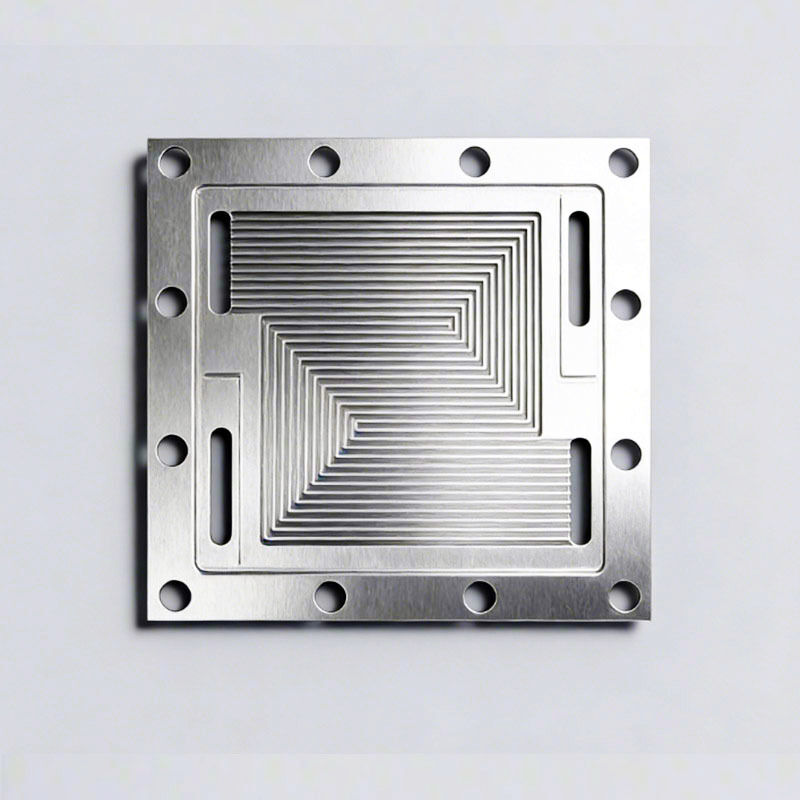
Custom Micro-Etched Titanium Flow Plate for Japanese Fuel Cells & Heat Exchangers
Flow Plates Overview
Our precision-etched metal flow plates are engineered for advanced fluid management applications, particularly in fuel cells, heat exchangers, and microfluidic systems. Manufactured using photochemical etching technology, these plates feature complex, high-density flow field patterns with exceptional accuracy and consistency. Ideal for applications requiring precise fluid control, thermal management, or gas diffusion.
Design Transfer: Digital CAD designs are translated to high-precision phototools.
Material Preparation: Selected metal sheets are cleaned and coated with photoresist.
UV Exposure: The flow pattern is exposed onto the photoresist-coated metal using UV light.
Chemical Etching: Unprotected areas are precisely etched away to create flow channels.
Cleaning & Inspection: Residual resist is removed, followed by thorough cleaning and dimensional verification.
Secondary Operations: Optional steps include forming, welding, surface treatment, or assembly with other parts.
Complex Geometries: Produce intricate, multi-depth channel designs without tooling limitations.
High Precision: Channel widths down to 0.015mm with ±0.01mm tolerance control.
Burr-Free Channels: Smooth, uniform flow paths without mechanical stress or deformation.
Material Versatility: Compatible with stainless steel, titanium, aluminum, copper, and specialty alloys.
Rapid Prototyping: Quick design iterations with minimal setup time.
Seamless Integration: Can include ports, alignment features, and sealing surfaces in a single piece.
| Parameter | Specification |
| Materials | Stainless Steel, Titanium, Aluminum, Copper, Nickel Alloys,etc |
| Thickness | 0.5mm - 3.0mm |
| Channel Width | 0.015mm minimum |
| Channel Depth | Up to 80% of material thickness |
| Dimensional Tolerance | ±0.01mm |
| Plate Dimensions | Up to 1800mm × 650mm |
| Surface Finish | Ra 0.2μm - 1.6μm (as etched), finer finishes available |
Fuel Cell Bipolar Plates: PEMFC, SOFC, and other fuel cell technologies
Heat Exchangers: Microchannel and plate-type heat exchangers
Microfluidic Devices: Lab-on-chip, medical diagnostic equipment
Chemical Process Plates: Reactor plates, mixing plates, distribution plates
Cooling Plates: Electronics cooling, laser cooling, power electronics
Sensor Components: Flow sensors, pressure sensors
No Hard Tooling: Eliminates mold costs and enables fast design changes.
Multi-Depth Etching: Create varied channel depths in a single etching process.
High Volume Capable: Efficient scaling from prototypes to mass production.
Material Expertise: Experience with corrosion-resistant and conductive alloys for demanding environments.
Quality Assurance: 100% dimensional inspection and leak testing available.
Fast Turnaround: Typically 7-10 days for prototypes, 2-4 weeks for production quantities.
Q: What materials are best for fuel cell flow plates?
A: 316L stainless steel offers excellent corrosion resistance and conductivity. Titanium provides superior strength and corrosion resistance for demanding applications. We can advise based on your specific requirements.
Q: Can you create different channel depths on the same plate?
A: Yes, our etching process can produce multiple channel depths in a single operation, allowing for optimized flow field designs.
Q: How do you ensure sealing surface flatness?
A: Our stress-free etching process maintains material integrity, and we can include additional flattening or surface finishing steps to achieve required flatness specifications.
Q: Can you etch micro-features on both sides of the plate?
A: Yes, we routinely produce double-sided etched plates with precise alignment between front and back patterns.
Q: Do you provide assembly services for stacked plate configurations?
A: Yes, we offer welding, bonding, and assembly services to create complete plate stacks or integrated modules.
Q: What file formats do you accept for design?
A: We prefer DXF, DWG, or STEP files, but can work with other common CAD formats.
![]()
Welcome to contact us at any time!
Rating global
Capture d'écran de notation
Voici la répartition de toutes les notesToutes les critiques